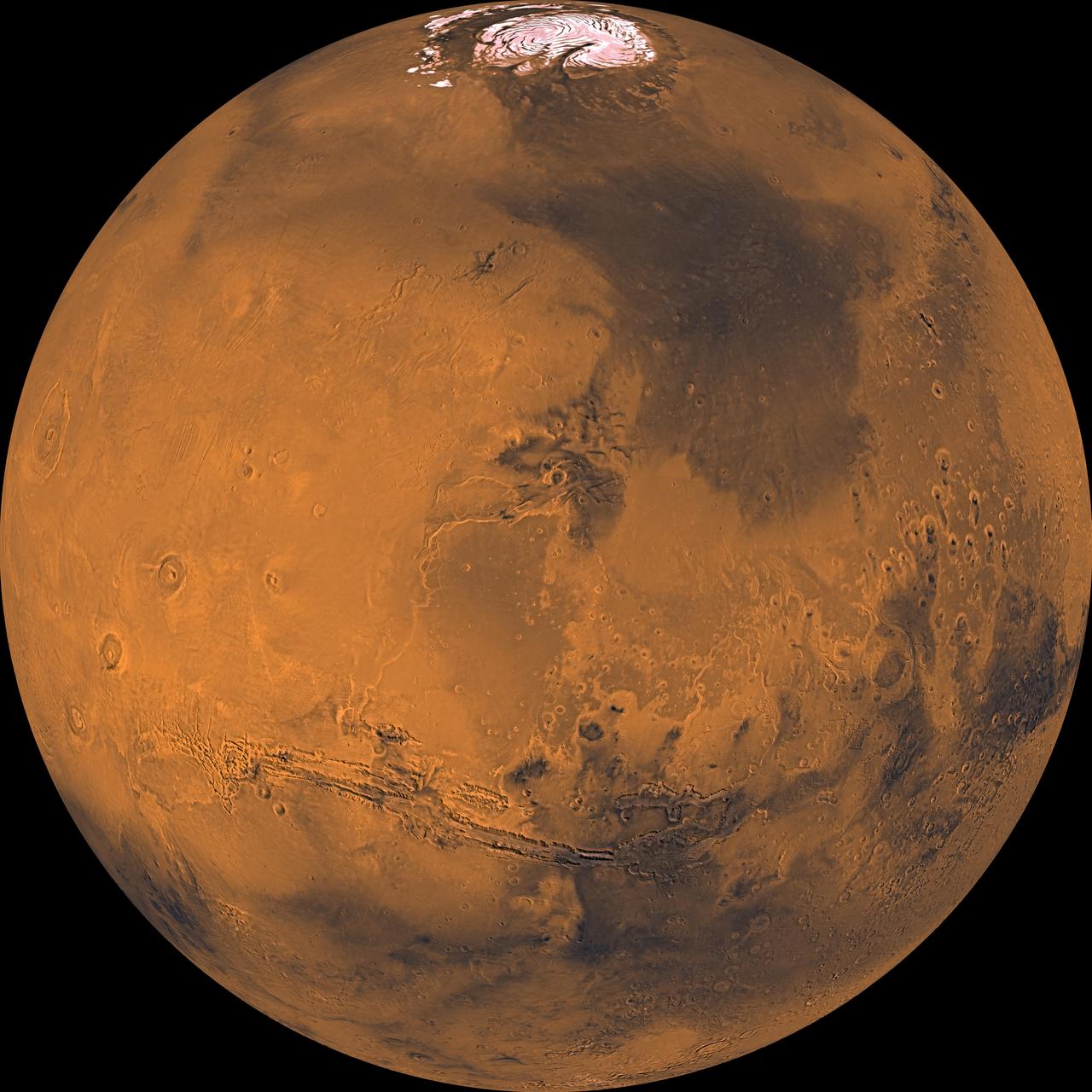
Mars
planetMars reaches magnitude -2.9 at a favorable opposition and is unmistakable for its orange-red color, caused by iron oxide dust covering the surface. At opposition (every 26 months), the disk reaches 25 arcsec and reveals polar ice caps, dark albedo features like Syrtis Major, and occasional dust storms that can engulf the entire planet. Tycho Brahe's precise positional measurements of Mars led Kepler to discover elliptical orbits. Named for the Roman god of war; the Egyptians called it Her Desher — the red one. Mars has been visited by more spacecraft than any other planet: Mariner 4 (first flyby, 1965), Viking 1 and 2 (first successful landers, 1976), Mars Pathfinder with Sojourner rover (1997), the twin Spirit and Opportunity rovers (2004, with Opportunity lasting until 2018), Curiosity (2012, still active), and Perseverance with the Ingenuity helicopter (2021). Key features visible in amateur telescopes include Olympus Mons (21.9 km, the tallest volcano in the solar system), Valles Marineris (4,000 km canyon system), and the seasonal advance and retreat of polar caps. Two small moons, Phobos and Deimos, require large apertures.